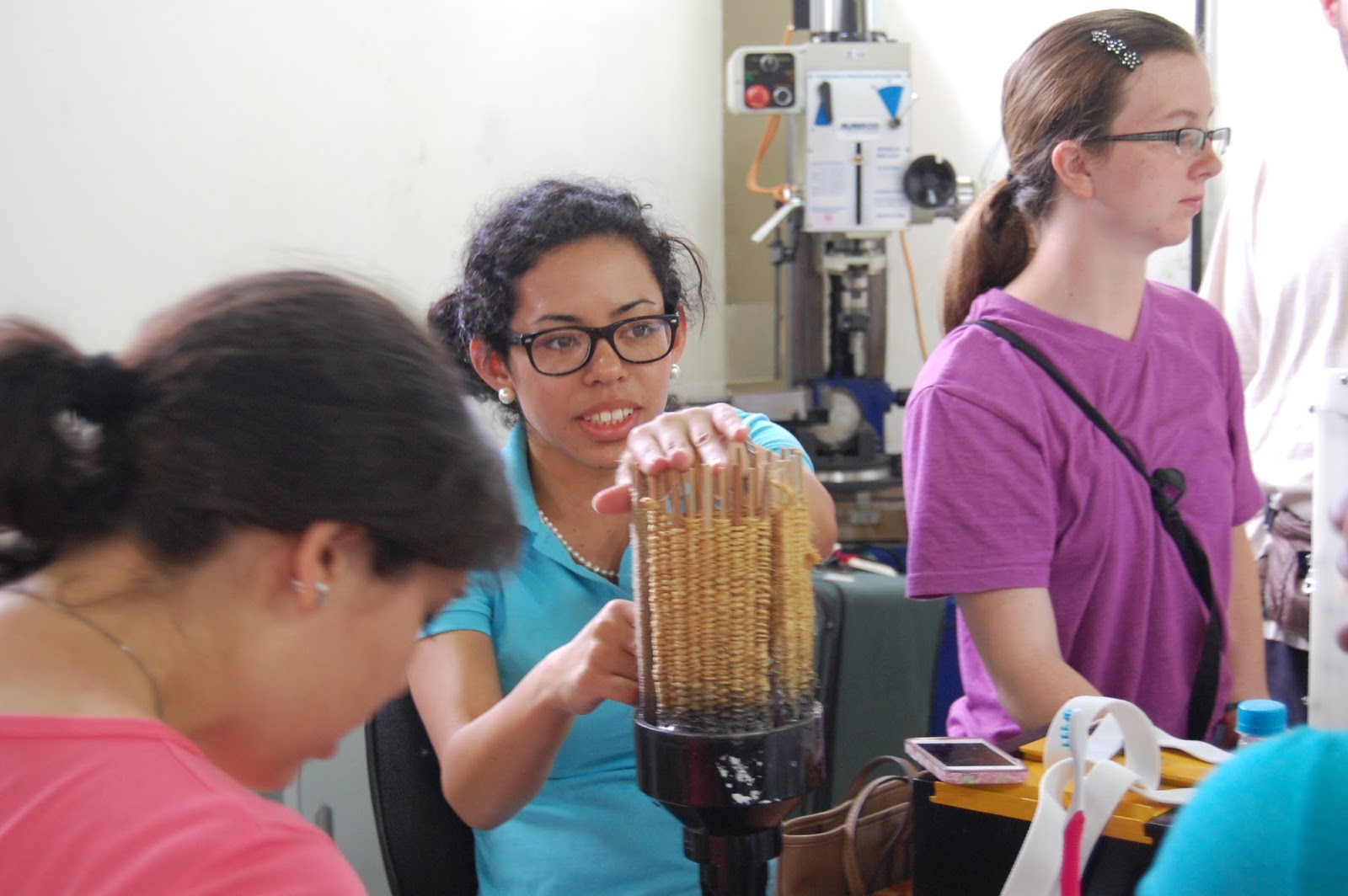
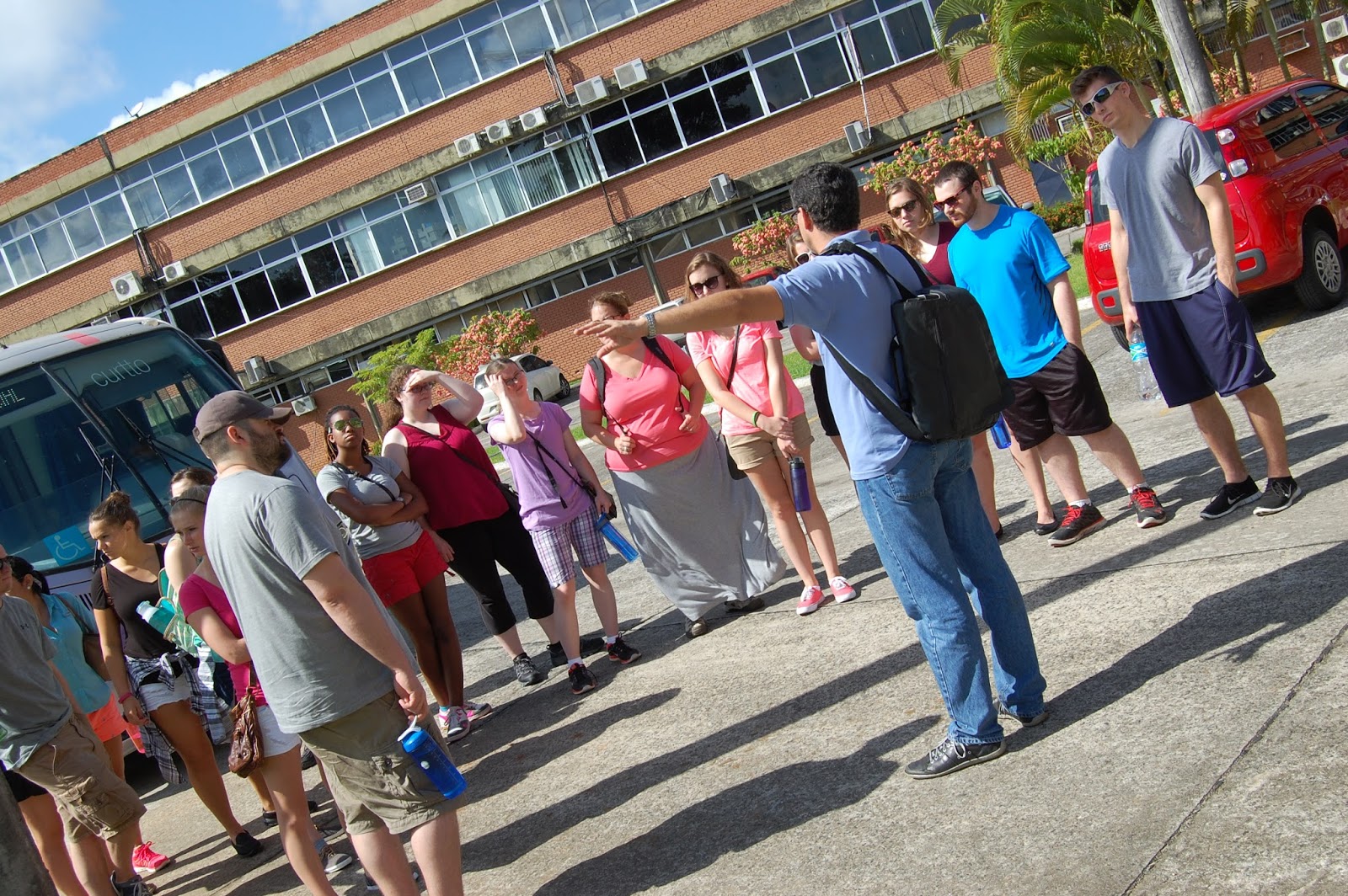
I'm going to catch up on some blogs...here are pictures from our visit with Mr. Milton on Monday!
Mission
The mission of the Program for Assistive Technologies for Underprivileged (PATU) is to allow students to practice engineering skills while they develop strong communication and teamwork skills, gain global perspective, and learn social responsibility through projects for persons with disabilities that otherwise could not afford assistance.
Saturday, June 13, 2015
Monday, June 8, 2015
Simple, lightweight, and affordable is the key
Today was the start of our very busy
mission-driven, service-learning, engineering-focused week. Professor Priscila from UESC connected us
with an institution called CEPEDI (
CENTRO DE PESQUISA E DESENVOLVIMENTO TECNOLÓGICO
EM INFORMÁTICA E ELETRO-ELETRÔNICA DE ILHÉUS), which is a company (not certain if it is for-profit or not) that does engineering development projects for companies. They are sort of like a consulting company. It was really cool and they had some facilities they let us use to work on getting our devices ready for delivery with tools and other machinery. Marcus, the leader of CEPEDI, was very nice and wanted to learn more about our projects and what we do. They are working to create more of a partnership with UESC for projects and I think this is one avenue that would be great!
After a
quick lunch we set off to see Mr. Milton in Itabuna. As usual, Mr. Milton and his wife, Nalva,
were happy to see us. It was very exciting to see the device that Chris and
Mitch made for him 2 years ago is hanging on his wall and still being used. He loves it!
After
explaining to the students about his accident (read his story here),
we began getting feedback from him about his prosthetics. If you recall, a couple years ago after our
trip, the students and faculty in the Engineering program at Sweet Briar
College did a fundraiser to purchase Mr. Milton commercially available
prosthetic arms (see previous
post). Last summer I did my best to try to deliver and do the final
adjustments to the straps for the arms.
Unfortunately,
Mr. Milton has not found the arms useful.
They do not fit well, they are heavy and hot, and the end effector (a
hook that opens and closes), does not suit his needs well. We have not yet been successful in finding a
prosthetist in the state that could help adjust it and further train him with
the devices.
However,
we have been further attempting to design a prosthetic arm that is more
affordable, breathable, adjustable, lightweight, and simple for people like
Milton. This work has been the focus of
my research efforts, and I have integrated it into course projects for the last
few years. Two years ago my students Holly and Adam designed a sleeve that
could be made out of local materials and that would be breathable and
adjustable (read their published work here). This year a group (Bill, Ron, Roxy, and
Ashton) designed the end of the prosthetic.
I was very impressed with their work and was excited to get Milton’s feedback
so we could make improvements in the future.
His
reception of the device was better than we could have ever hoped for. HE LOVED IT! He thought it was great because
it was light weight and simple. In a
matter of about a half an hour we had it close to fitting him with only a few
adjustments. Ashton and Roxy worked with
him to better understand the advantages and disadvantages of the
prototype. With only a few simple fixes
we think we may be able to leave it with him on Friday! This result is far
better than we ever could have hoped for!
He didn’t want us to take it with us today!
I know I
left Milton’s home more excited than ever.
I can’t wait to see how well the other devices work out. We’ve done some interesting projects, but now
that our focus is on making them with simple materials so that they can be
reproduced here and by the people who need them the most, that we are now truly
making a different.
Reflection:
What is happiness? Have your ideas of happiness changed since the start of this
trip?
Sunday, June 7, 2015
Unplug to connect
As a group we went to Itacare for the long holiday weekend, where the students got to enjoy many cool things about Brazil, like paddle boarding and kayaking on the ocean, dancing Forro, eating and hanging out at the beach, hiking through the jungle to a secluded beach, and eating at Casa de Empada.
One thing we did NOT experience was internet for three whole days! I thought it was a good opportunity to ask the students to reflect on how we communicate and how we are so connected. Here is the reflection I posed to them today (they get a reflection question each day as part of their course requirements):
"We seem to live life overly connected-everyone has their phones in their hands constantly texting, emailing, or connecting to friends and family through social media. Five years ago most of the significant social media wasn't available on phones. Ten years ago it was barely available at all. Fifteen years ago there was no texting and 20 years ago no cell phones (practically). Have you observed the connectedness of the people of Brazil? Not just those who are in our group, but all of the people in the cities we are in. How do they compare to those in the U.S.? How does this change us? What does this say about our culture?"
Enjoy! Tomorrow we begin the real journey.
Friday, June 5, 2015
A day to relax, reflect, and experience new things
Thursday, June 4, was a holiday in Brazil (Body of Christ, celebrating the death of Jesus). It was sort of a "free day" for us, but it was a great opportunity for everyone to relax, reflect, and experience new things.
Many students explored Ilheus and Itabuna with their hosts. It was great to see all of the different Facebook posts as they ventured out! Ally got to go paddleboarding. Victoria went to a cacau plantation. Several students went to a festival celebrating the holiday. A few students and their host families also came to the hotel and walked on the beach, swam in the ocean, and played games with Katie and Chloe. Overall it was a very fun day!
Of course, we also did some work. It was time to organize all of the donations! Students went through each of our 20+ suitcases and organized them so we are all ready to go on Monday morning.
Then in the evening Marcelo took those of us who were around (Katie, Chloe, Ally, Geordon, and I), downtown for a little tour of Ilheus. We stopped at the Jesus Christo statue and took some photos...and were easily pegged as tourists as people approached us just to practice their English :) It was a fun experience though!
Then we walked around the square. It was really cool to see the "carpet" that was created for the march for the holiday.
Then we had dinner. We had a "plate of meat" and boy was it delicious!
Today we head to Itacare to experience the jungle and beach. I will be back with updates on Sunday. Tchiao!
Wednesday, June 3, 2015
Adventures in Brazilian travel, Brazilian BBQ, and Engineering
After an adventurous journey to get here (it’s just not fun
if there aren’t a few travel hitches here and there, right?), we are back in
Brazil and have hit the ground running. The majority of our crew (17 of 19)
arrived yesterday about 1:00PM and enjoyed some swimming and relaxing. Two of us didn’t get in until midnight and
quickly crashed to rest up for today.
After a great tour and cultural orientation (thanks
Marcelo!), we hit up my favorite Brazilian steakhouse, Los Pampas. It’s the kind of place where they walk around
with all sorts of grilled meats on a skewer and cut off chunks of them right
in front of you. DELICIOUS! I must say their desserts are also fantastic. Great way to start the trip!
In the afternoon I had the unique and wonderful opportunity
to be a guest lecturer and conduct a workshop for students in the engineering
programs at UESC (Universidade Estadual de Santa Cruz). I have to admit that I was a bit nervous when
I saw large posters hanging up with my photo on them!! Everyone was so excited to have me there, and
I even met (and had my photo taken with) many important people. I feel so honored!
The topic of the presentation was “Engineering for persons
with disabilities.” It really meant a lot to me to share my passion with so
many (there were nearly 100!) Brazilian engineering students. Did you know:
·
Around 15% of the world's population, or
estimated 1 billion people, live with disabilities. They are the world's
largest minority.
·
Eighty per cent of persons with disabilities
live in developing countries
·
19 per cent of less educated people have
disabilities, compared to 11 per cent among the better educated.
·
The World Bank estimates that 20 per cent of the
world's poorest people have some kind of disability
·
30 per cent of street youths have some kind of
disability
·
Unemployment among the persons with disabilities
is as high as 80 per cent in some countries.
Those with disabilities experience greater unemployment
rates, increased poverty, and even larger mortality rates than persons that do
not have disabilities. It seems that
there is a vicious circle—people living in poverty are more likely to have a
disability, and if they have a disability they’re more likely to live in
poverty. We as engineers can help to break this cycle by providing
life-changing technologies to help those with disabilities improve their daily
lives and to be able to work for a living; to empower them.
I challenge everyone, especially my engineering students, to
find a way to make a difference in the world through service-learning. We
brainstormed in small groups to think of projects that they could do right here
in their communities to provide a service as well as learn while doing it (we
call this Service-Learning). One group,
proposed helping communities develop a system for recycling. Another suggested researching and
implementing systems for improved accessibility in the community.
It was really wonderful to hear the great ideas the students
came up with and just to see how engaged and excited they were about the topic.
Several students came to me afterward to ask how they could be involved with
our projects. It’s so very exciting for
me to be able to foster excitement for my work with students!
Thank you, Katie Van Blair, for contributing your knowledge
of Social Justice to the presentation—I know the students found it fascinating!
Thank you, Priscila Suzart, for inviting me to lecture and for all of the
planning you did to make it happen. And
thank you, Marcelo Pires de Oliveira, for all of your hard work and seamless
translation of my presentation to Portuguese. THANK YOU!!!
Friday, November 22, 2013
We are trying our hardest to provide our dear patient, Mr. Milton, with simple upper limb prosthetics to improve his daily living by this May. Check out the story here: http://sbc.edu/news/engineeri ng-science/mr-miltons-arms/
Subscribe to:
Posts (Atom)